
Calculating your ecological footprint will allow you to limit your impact on the planet.
The term “Ecological Footprint” was defined by Wackernagel and Rees in 1996 in the book “Our Ecological Footprint: Reducing Human Impact on the Earth”(1). This work focuses on the concept of the Ecological Footprint, a measurement tool that indicates the amount of biologically productive land and water we use to sustain our lifestyle. In other words, it shows us how much nature we ‘spend’ each year. While there are other metrics to assess environmental impact, the Ecological Footprint offers a comprehensive view of our demand on natural resources.
Regarding the authors of this work, William Rees is a professor, biologist, and ecologist, and Mathis Wackernagel is a mechanical engineer and current president of the Global Footprint Network(2). The Global Footprint Network 2014 data highlight a significant inequality in resource consumption worldwide. While the global average ecological footprint is 2.8 hectares per person, and what the Earth can offer is 1.7 ha per capita, this figure hides vast disparities between countries and regions(3). For example, the 2018 ecological footprint in the United States was 5.1, in Spain 2.8, and in Mexico 1.5. To learn about the footprint of the country and the year, and more specific data, in other words during 2018, we overused earth´s resources(4).
It is advisable to calculate your ecological footprint considering two main factors(5):
- The planet’s biocapacity: the Earth’s ability to regenerate the natural resources we use.
- Human activity: this includes resource consumption and waste generation, both solid and emissions.
An ecological deficit occurs when the ecological footprint of a population exceeds the biocapacity of the place where it lives.
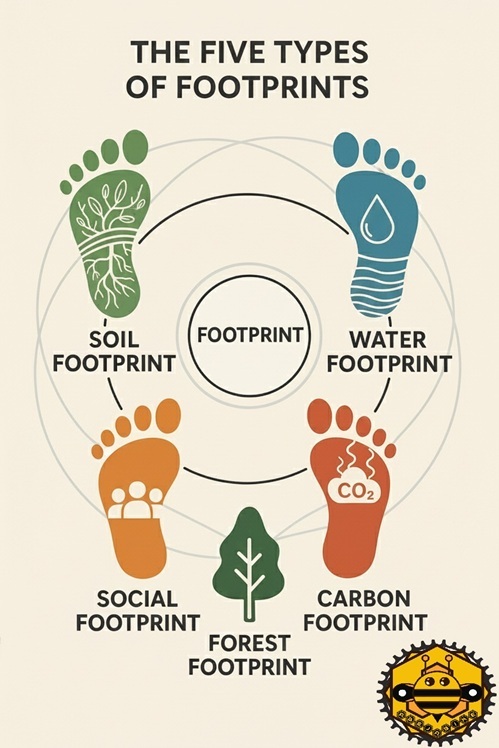
According to researchers, there are different types of footprints. We will mention the five types of footprints common in our daily lives. Although there are more footprints, we want to simplify it to clarify this important concept.
1. Soil Footprint (Cropland)
This indicator refers to the amount of land we use to feed ourselves. The concept is based on the amount of biologically productive land needed per person to maintain their lifestyle. Furthermore, this indicator includes livestock feed, which occupies a lot of land. According to a 2019 Greenpeace report, more than 70% of all agricultural land in the EU is dedicated to livestock feed(6).
2.Water Footprint – Water Consumption
Researcher John Anthony Allan, from King’s College London, coined the concept “virtual water” in 1993(7). Virtual water is the volume of water consumed or polluted to produce a product, good, or service, measured throughout its production chain. In 2002, Arjen Hoekstra based his work on Allan’s virtual water concept to develop the “water footprint” framework, creating three types of water (blue, green, gray) to indicate when and where it is used. The difference between virtual water and water footprint is a multidimensional indicator. We recommend reading Ana Santos Gilsanz’s book “Vivir Sin Huella” (Living Without a Footprint), an essential book for understanding and reducing your water footprint(8).
The Water Footprint is not only the water we use to shower or prepare food or the water we drink. We must also consider that everything we consume requires water for its production. The footprint can be measured in liters of water, some examples of the products we consume in our daily lives(9), such as:
- 13,000 to 15,000 liters of water are needed to produce 1 kg of beef.
- 3,920 liters of water = 1 kg of chicken.
- 3,000 liters of water = 1 kg of rice.
Now imagine the amount of water used to manufacture clothes, cars, electronic devices, and a long list of daily consumer products. UNESCO indicates that in 2022, ‘approximately half of the world’s population suffered severe water scarcity during at least part of the year, and a quarter faced ‘extremely high’ levels of water stress, using more than 80% of their total annual renewable freshwater supply’(10). Therefore, saving water is directly related to reducing your consumption.
3. Carbon Footprint
The carbon footprint is an environmental indicator that reflects the amount of greenhouse gases (GHG) generated by human activities through energy production, fuel burning, or methane generation. It is expressed in terms of CO2 equivalent, which represents the totality of greenhouse gases emitted, directly or indirectly, by an activity. This footprint has been essential for the implementation of local, regional, and international measures; for example, the Paris Agreement(11).
In 2020, the EU committed to reducing its emissions by at least 55% by 2030 compared to 1990 levels, as a step towards achieving neutrality by 2050(12). The carbon footprint can be offset with the plantation of trees. Trees have the capacity to absorb carbon, and while this may vary for each tree depending on its species or other factors, in general, a tree absorbs approximately between 10 kg and 30 kg of CO2 per year. According to estimates, 22 trees are required to supply a person’s daily oxygen demand(13).
The European Union aims to reduce and halt Greenhouse Gas emissions, with a roadmap for the coming decades(14). For example, the regulation called Euro 6d, which since 2020, establishes a maximum amount of emissions: 120 for diesel and 90 for gasoline, in grams of CO2 per kilometer(15).
4. Forest Footprint – Disappearance of Primary Forests
What are Primary Forests?
Primary forests are composed of native species that show no evidence of human intervention and whose ecological processes remain mostly intact. Currently, at least 1.11 billion hectares of primary forests still exist in the world(16).
The Forest Footprint is an indicator that quantifies the forest area affected, directly or indirectly, by the consumption of certain products. This indicator focuses on eight basic products with a high risk of deforestation, which include: palm oil, soy and other oilseed crops; coffee, cocoa and other tropical crops; wood and derived products; meat and animal products(17).
Unfortunately, industrial agriculture, especially the expansion of monocultures such as soy and oil palm, is a major driver of the Forest Footprint, being one of the leading causes of global deforestation(18).
The total loss of tropical primary forests in 2023 reached a total of 3.7 million hectares, equivalent to losing almost 10 football fields of forest per minute. While this represents a 9% decrease compared to 2022, the rate in 2023 was almost identical to those of 2019 and 2021. All this forest loss produced 2.4 gigatonnes (Gt) of carbon dioxide emissions in 2023(19).
5. Social Footprint – Who Manufactures Our Products?
Although it may not always be obvious, the social impact of businesses is a fundamental indicator. Companies should implement ethical and fair labor practices that guarantee good working conditions, social protection, and greater attention to the health of their employees. Likewise, it is crucial to invest in occupational safety and in the professional development of their personnel through continuous training. The way of doing business, based on fair competition and respect for the law, also leaves a significant footprint on society.
Labor exploitation is often disguised with the false narrative of “employment opportunity.” However, behind this facade, brutal realities are hidden: undignified wages, unsafe workplaces, excessively long working hours, and a complete lack of dignity. This exploitation disproportionately affects the most vulnerable groups, even reaching child and women exploitation.
It is estimated that 50 million people worldwide live in a situation of modern slavery(20). This global phenomenon is present in almost all countries, transcending ethnic, cultural, and religious lines. Modern slavery is understood as a situation in which people are forced to work in inhuman conditions and without the possibility of escaping, due to threats, abuse of power, or manipulation.
The International Labour Organization (ILO) estimates that there are 152 million children working worldwide(21). Many of them start working before learning to read or write, which robs them of their childhood, keeps them away from school, and violates their dignity.
The magnitude of precarious conditions in the workplace became tragically visible with the collapse of the Rana Plaza building in Bangladesh. On April 24, 2013, this eight-story block collapsed in Savar, a district of Dhaka, the capital of Bangladesh. The tragic event resulted in the death of 1,134 people and left another 2,437 injured(22). The collapse of Rana Plaza has become a global symbol of the urgent need for safe and fair working conditions in the global industry.
While low-cost products seem inexpensive upfront, their true price includes overlooked environmental and social harm.
Reference 1 - Our Ecological Footprint: Reducing Human Impact on the Earth
Wackernagel, Mathis, and William E. Rees. Our Ecological Footprint: Reducing Human Impact on the Earth. New Society Publishers, 1996
Reference 2 - Global Footprint Network
Foot Print Network.org (2025)
https://www.footprintnetwork.org/about-us/our-history/
Reference 3 - Global Ecological Footprint in 2014
Foot Print Network ORG (2018)
Has humanity’s Ecological Footprint reached its peak?
https://www.footprintnetwork.org/2018/04/09/has_humanitys_ecological_footprint_reached_its_peak/
Reference 4 - How many Earths? How many countries?
Over shoot footprint network org (2018)
https://overshoot.footprintnetwork.org/how-many-earths-or-countries-do-we-need/
Reference 5 - Ecological Footprint Accounting for Countries
Lin, D., Hanscom, L., Murthy, A., Galli, A., Evans, M., Neill, E., Mancini, M. S., Martindill, J., Medouar, F.-Z., Huang, S., & Wackernagel, M. (2018). Ecological Footprint Accounting for Countries: Updates and Results of the National Footprint Accounts, 2012–2018. Resources, 7(3), 58. https://doi.org/10.3390/resources7030058
Reference 6 - Greenpeace - Más del 70% de las tierras agrícolas de la UE no se destinan a alimentación humana sino de ganado
Greenpeace – (2019) Más del 70% de las tierras agrícolas de la UE no se destinan a alimentación humana sino de ganado.
https://es.greenpeace.org/es/sala-de-prensa/comunicados/mas-del-70-de-las-tierras-agricolas-de-la-ue-no-se-destinan-a-alimentacion-humana-sino-de-ganado/
Reference 7 - Aguas Residuales info - Agua virtual: el legado de J. Anthony Allan
Aguas Residuales (13 de febrero de 2021). Agua virtual: el legado de J. Anthony Allan [Virtual water: The legacy of J. Anthony Allan]. Aguas Residuales.info. Recuperado de
https://www.aguasresiduales.info/revista/noticias/agua-virtual-el-legado-de-j-anthony-allan-kRs7
Reference 8 - Ana de Santos Gilsanz - Vivir sin huella
Santos Gilsanz, A. de (2023). Vivir sin huella: Las claves para reducir el impacto ambiental en tu día a día. Zenith.
Reference 9 - Statista - Más de 15.000 litros de agua por cada kg de carne de res
Mena Roa, M. (2022, Septiembre 6). Más de 15.000 litros de agua por cada kg de carne de res [More than 15,000 liters of water per kilogram of beef]. Statista. Recuperado de
https://es.statista.com/grafico/8316/gasto-de-agua-de-alimentos/
Reference 10 - UNESCO. Water crises threaten world peace.
UNESCO. (2024, March 29). Water crises threaten world peace. Retrieved from https://www.unesco.org/en/articles/water-crises-threaten-world-peace-report
Reference 11 - ClimateTrade. The evolution of carbon footprint measurement.
ClimateTrade. (2022, August 18). The evolution of carbon footprint measurement. Retrieved from https://climatetrade.com/the-evolution-of-carbon-footprint-measurement/
Reference 12 - European Council. Paris Agreement on Climate Change.
European Council. (n.d.) (19 September 2025). Paris Agreement on Climate Change. Section: Objectives of the Agreement. Retrieved from https://www.consilium.europa.eu/en/policies/paris-agreement-climate/
Reference 13 - Selectra Climate Consulting. ¿Cuánto CO2 absorbe un árbol?.
Garrett, C. (2021, February 11). ¿Cuánto CO2 absorbe un árbol? Selectra Climate Consulting. Retrieved from https://climate.selectra.com/es/actualidad/co2-arbol
Reference 14 - Ministerio para la Transición Ecológica y el Reto Demográfico. La Unión Europea en la lucha contra el cambio climático.
Ministerio para la Transición Ecológica y el Reto Demográfico. (s.f.). La Unión Europea en la lucha contra el cambio climático. Ministerio para la Transición Ecológica y el Reto Demográfico. Retrieved from
https://www.miteco.gob.es/es/cambio-climatico/temas/el-proceso-internacional-de-lucha-contra-el-cambio-climatico/la-union-europea.html
Reference15 - RACE. Emisiones CO2 coche: ¿Qué dice la ley? ¿Cuál es el límite de emisiones de CO2 de los coches?
RACE. (s.f.). Emisiones CO2 coche: ¿Qué dice la ley? ¿Cuál es el límite de emisiones de CO2 de los coches? RACE. Retrieved from:
https://www.race.es/emisiones-co2-coche-que-dice-ley#:~:text=La%20normativa%20que%20se%20aplica,para%20di%C3%A9sel%20y%20gasolina%2C%20respectivamente.
Reference 16 - FAO - Primary forests cover about one billion hectares.
Global Forest Resources Assessment 2020 – Retrieved from:
https://www.fao.org/interactive/forest-resources-assessment/2020/en/
Reference 17 - Envol Vert. Forest Footprint Methodology.
Envol Vert. (22 noviembre 2024.). Forest Footprint Methodology. [Envol Vert – Association for the Protection of Tropical Forests]. Retrieved from https://envol-vert.org/en/methodology/
Reference 18 - World Resources Institute - Los incendios impulsaron una pérdida récord de bosques tropicales en el 2024
Weisse, M., Goldman, E., & Carter, S. (4 de abril de 2024). Forest Pulse: La información más reciente sobre los bosques del mundo. World Resources Institute Research. https://research.wri.org/es/gfr/latest-analysis-deforestation-trends
Reference 19 - World Resources Institute - How much forest was lost in 2023?
Weisse, M., Goldman, E., & Carter, S. (4 de abril de 2024). Forest Pulse: How much forest was lost in 2023?. World Resources Institute Research.
https://gfr.wri.org/global-tree-cover-loss-data-2023
Reference 20 - International Labour Organization - 50 million people worldwide in modern slavery
International Labour Organization, Walk Free and the International Organization for Migration 12 September 2022 – Retrieved from:
https://www.ilo.org/resource/news/50-million-people-worldwide-modern-slavery-0
Reference 21 - International Labour Organization (ILO) - Estimates that there are 152 million children working worldwide
International Labour Organization 12 November 2019 – Retrieved from:
https://www.ilo.org/publications/measuring-child-labour-forced-labour-and-human-trafficking-global-supply
Reference 22 - DW (2024) - Rana Plaza disaster 11 years on: What has changed?
Shristi Mangal Pal – April 23, 2024 – Rana Plaza disaster 11 years on: What has changed?
Retrieved from:
https://www.dw.com/en/rana-plaza-disaster-11-years-on-what-has-changed/a-68900666
Now, tell us:
And do you measure your daily footprint?
How many resources do you use, and how much can you reduce?
Shorter showers, fewer plastic bottles, fewer coffee cups, etc.
Share your comments with us!
