
Remember the Rs – Think of the Planet and People
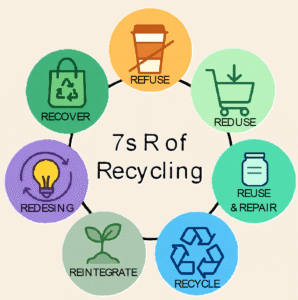
We have evolved from the linear model of ‘Reduce, Reuse, and Recycle’(1) towards a more circular approach. This transition is due to the finite nature of raw materials and the increasing depletion of natural resources, facing a growing demand. The circular economy seeks to incorporate at least two additional principles: the aim of extending the useful life of products and minimizing waste generation.
1. Refuse
- If you’re getting your morning coffee, refuse single-use packaging! Bring your own thermos!
- It’s not necessary to be fashionable, even if advertising and trends dictate; buy quality clothing, look for companies in your country, and consider fast fashion, which often has workers in terrible conditions.
- Imagine this: if a million people in our city and country consume one coffee every day in disposable cups, plastic bags, plastic water bottles, and all the packaging we use daily. In addition to visible waste, there’s also the so-called invisible waste(2).
2. Reduce
- Especially when doing your weekly shopping, make a list of the meals you’ll prepare for yourself or your family. Avoid overbuying, as this leads to food waste. If you use your car for all your trips, try to reduce its use. Opt for public transport or, even better, the bicycle, our favorite vehicle.
- Many materials, especially plastics, degrade over time and create environmental problems. Therefore, we must prioritize reducing waste at the source.
3. Reuse and Repair
- Here, we’ll focus on two key concepts: reduce and reuse. For example, you can reuse a glass jar with a lid, which previously contained honey, to store nuts, walnuts, or coffee. Another example is denim pants. If a button breaks or they get slightly damaged, don’t throw them away! They can surely be repaired. Believe us, no one will notice you fixed a button.
4. Recycle
- Recycling involves much more than just separating waste, although this action is fundamental. In addition to separating waste, it’s crucial to deposit it in the appropriate containers: glass, paper, plastic, organics (including food and garden waste), and general waste. Most cities are investing in improving their waste collection and treatment systems.
- Each of us can make a difference! Let’s learn about our local recycling programs! Let’s reduce the consumption of disposable products and promote more sustainable consumption habits.
5. Reintegrate
- Here’s a slight variation, especially from the Zero Waste movement(3). This R is called ‘Rot’(4) and refers to the composting process, that is, transforming organic matter into fertilizer. Although not everyone has, the possibility to compost at home.
- When we recycle or separate waste, organic waste in certain cities is processed, but there are also private companies that recover this waste for its use(5). These private companies recover this organic waste to transform it into useful products.
However, there are other Rs in the system that are more focused on waste production and disposal. If you own a business or work in a company, you can explore these other options to reduce your environmental footprint.
6. Redesign
- Redesigning sustainability involves rethinking the entire life cycle of a product or system, from its conception to its end of useful life. Also known as the circular economy, it aims to minimize environmental impact and maximize resource efficiency(6). A good example of this practice can be seen in the textile industry, for example, with the redesign of materials to produce clothing(7). WRAP (Waste & Resources Action Programme) is a UK-based organization that specializes in reducing resource waste and promoting the circular economy in various sectors, including textiles(8).
7. Recover
Most plastic waste consists of single-use packaging. Therefore, companies offer their customers innovative and sustainable solutions, such as the following:
- Restaurants/food businesses: They can offer their customers reusable and durable containers with the business’s brand. Upon return, they will get a discount on their next purchase. This initiative not only reduces waste but also promotes customer loyalty.
- Moving companies: They can optimize operations by using reusable plastic boxes of a standard size. This will allow them to accommodate items safely and efficiently, in addition to significantly reducing packaging material costs. Implement a deposit and return system to ensure the project’s sustainability.
- Cleaning product stores: Offer customers the possibility to refill their containers. In addition to reducing plastic consumption, this system promotes the circular economy and rewards customer loyalty.
Reference 1 - Pelin Ofluoğlu - Ege University - Using Five-R Analysis For Sustainable Supply Chain Management In Clothing Sector.
Ofluoğlu, P. (2014, enero). Using Five-R Analysis For Sustainable Supply Chain Management In Clothing Sector. Ege University.
Reference 2 - Van Yken, J., Boxall, N. J., Cheng, K. Y., Nikoloski, A. N., Moheimani, N. R., & Kaksonen, A. H. (2021). E-Waste Recycling and Resource.
Van Yken, J., Boxall, N. J., Cheng, K. Y., Nikoloski, A. N., Moheimani, N. R., & Kaksonen, A. H. (2021). E-Waste Recycling and Resource.
Recovery: A Review on Technologies, Barriers and Enablers with a Focus on Oceania. Metals, 11(8), 1313.
https://doi.org/10.3390/met11081313
Reference 3 - Zero Waste Europe (2024). Learning from the global zero waste movement at the 2024 International Zero Waste Cities Conference.
Zero Waste Europe. (July 23, 2024). Learning from the global zero waste movement at the 2024 International Zero Waste Cities Conference.
Retrieved from https://zerowasteeurope.eu/2024/07/learning-from-the-global-zero-waste-movement-at-the-2024-international-zero-waste-cities-conference/
Reference 4 - U.S. Environmental Protection Agency (EPA). (2023.
U.S. Environmental Protection Agency (EPA). (October 2023). Composting. [US EPA website].
Retrieved from
https://www.epa.gov/sustainable-management-food/composting
Reference 5 - Ecocycle. (s.f) (2024). The 8th State of Recycling and Composting Report Outlines Colorado’s Waste Reduction Successes
Ecocycle. (s.f). The 8th State of Recycling and Composting Report Outlines Colorado’s Waste Reduction Successes. [Ecocycle website].
Retrieved from https://ecocycle.org/sorc-report-2024/
Reference 6 - Jindal Global University. (2024). The future of sustainable architecture: Trends and innovations.
Jindal Global University. (February 27, 2024). The future of sustainable architecture: Trends and innovations. [Jindal Global University blog].
Recovered from
https://jgu.edu.in/blog/2024/02/27/the-future-of-sustainable-architecture-trends-and-innovations/
Reference 7 - Suarez-Visbal, L. J., Rosales-Carreón, J., Corona, B., Alomoto, W., & Worrell, E. (2024). Walking the circular talk.
Suarez-Visbal, L. J., Rosales-Carreón, J., Corona, B., Alomoto, W., & Worrell, E. (2024). Walking the circular talk: Analyzing the soft and hard aspects of circular economy implementation of ten business cases within the textile and apparel value chain. Journal of Cleaner Production, 476, 143683. https://doi.org/10.1016/j.jclepro.2024.143683
Reference 8 - WRAP (Waste & Resources Action Programme) (n.d). Transforming the World´s Texiles System.
WRAP (Waste & Resources Action Programme) (n.d). Transforming the World´s Texiles System.
Retrived from https://www.wrap.ngo/what-we-do/transform-textiles
Now, tell us:
Do you apply these Rs to your daily life?
What other examples would you share?
Share your comments with us!
